| http://collections.lacma.org/node/214134 |
 |
| http://www.vam.ac.uk/content/articles/c/crinolines-crinolettes-bustles-corsets-1860-1880/ |
 |
| http://www.philamuseum.org/collections/permanent/153082.html?mulR=10512|4 |
We're not going to talk as much about these kind of corsets:
| Pre-1850 |
| Corded Pre-1850 |
So where do you start your search for a historically accurate corset? I like to start at museums. There are many collections out there that are searchable and yield some excellent results:
Philadelphia Museum of Art
Museum of Fine Arts: Boston
Metropolitan Museum of Art
LACMA
Augusta Auctions
Tasha Tudor Auction
Antique Corset Gallery
You can use these databases to pinpoint the finer examples of your chosen time period, but here's a brief overview. Keep in mind we're working with generalizations, and you'll always be safer researching your own examples of the corset you'd like to make.
In the 1850's and 60's the emphasis in fashion was on a narrow waist accentuated by a belled skirt. The main goal of corseting was to support the bust and slim the waistline while also providing a firm foundation to hang all those skirts off of. Corsets were short and generally came up to mid-bust, which was tall enough to support the bust but not long enough to be modest without the accompanying chemise. The corsets generally laced in back and closed in the front with a separating busk:
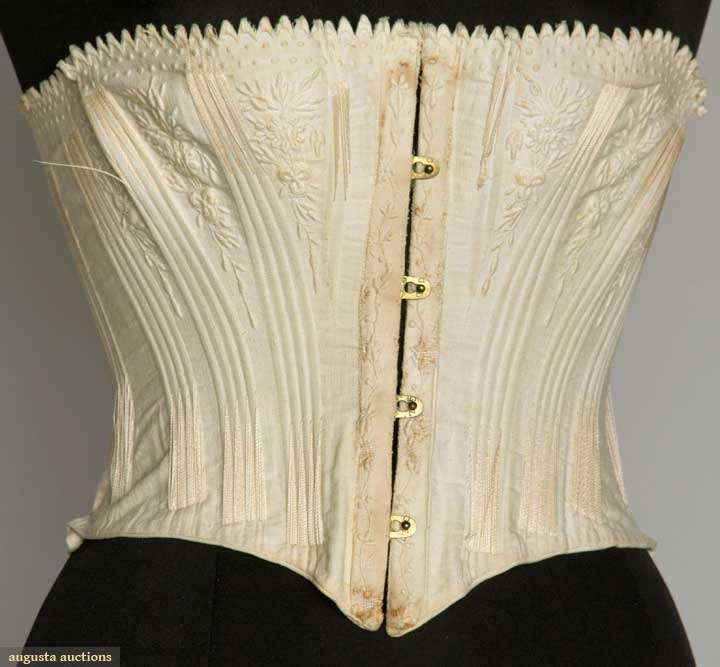 |
| http://www.augusta-auction.com/list-of-upcoming-sales?view=lot&id=12871&auction_file_id=27 |
| http://blog.fidmmuseum.org/museum/2012/11/blue-corset-c-1868-1874.html |
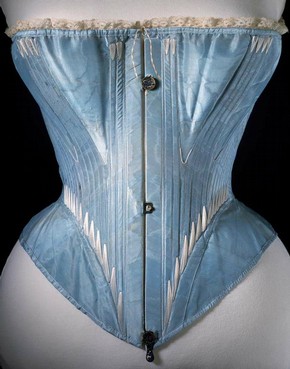
In the late 1860's and continuing into the 1870's skirts started to narrow, putting more of an emphasis on the hip and stomach area. Corsets got longer at the bottom to give these areas more control:
 |
| http://www.augusta-auction.com/component/auctions/?view=lot&id=4788&auction_file_id=8 |
 |
| http://metmuseum.org/Collections/search-the-collections/80096294 |
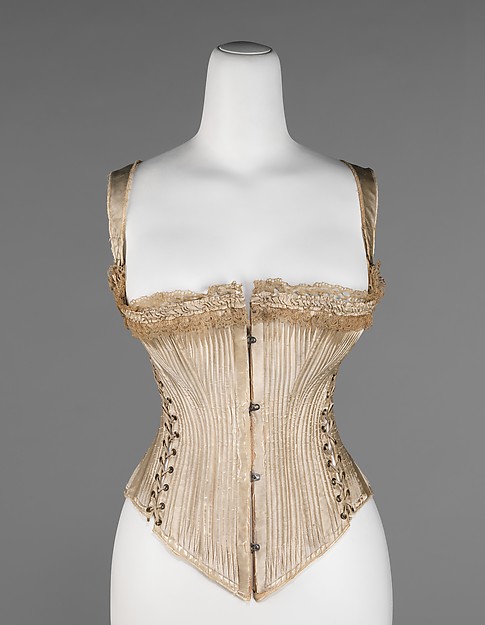
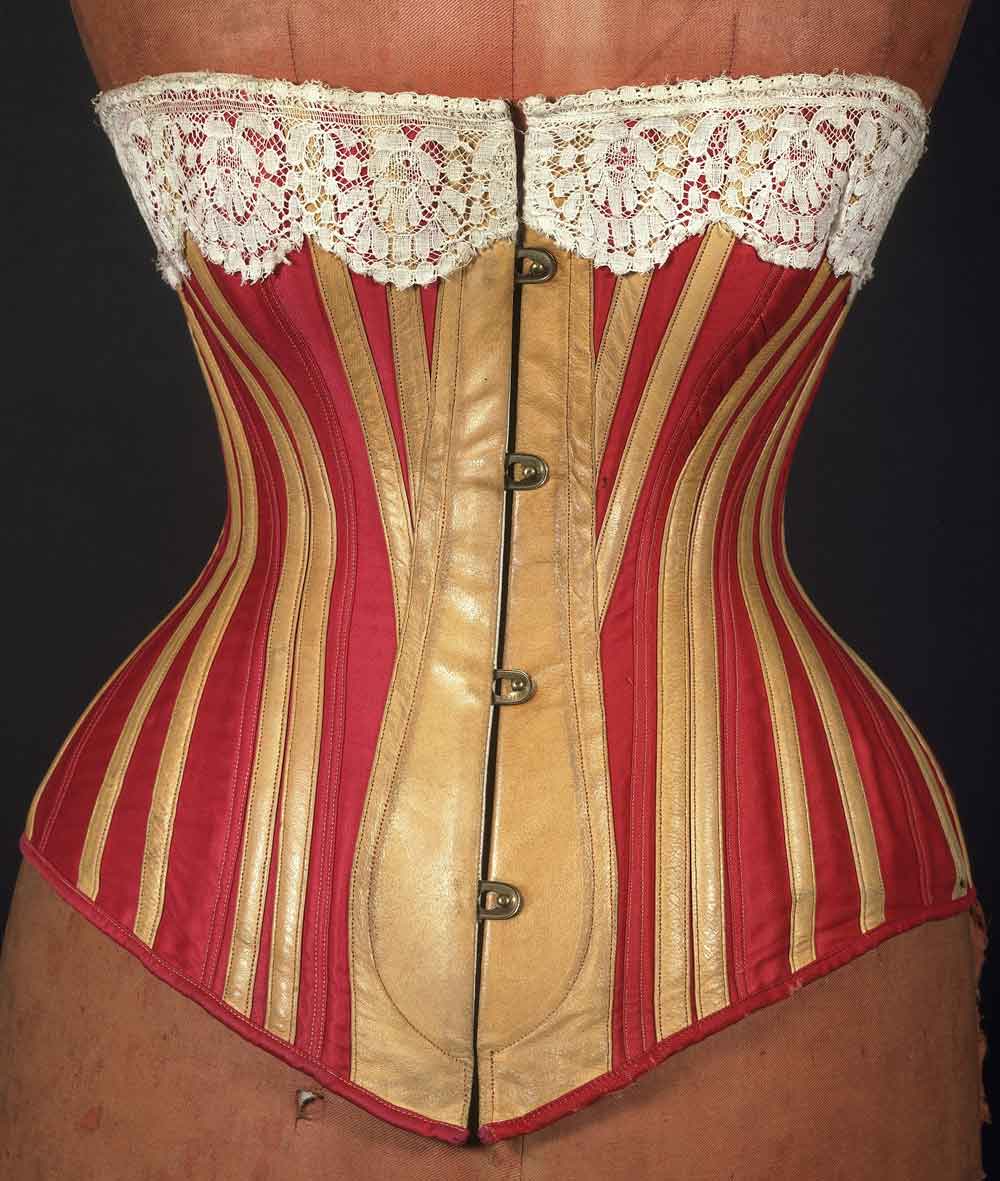
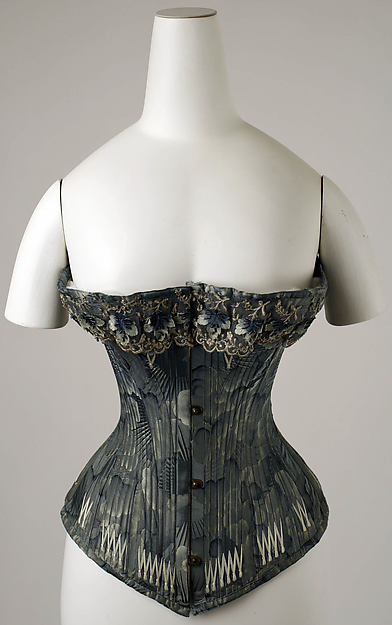
In 1879 the Spoon Busk was invented. This busk, which is larger at the bottom, provides support to a lower stomach pouch that is created when the waist is constricted more for reduction and less for compression. As corsets in the late 1870's and 1880's were drawn tighter there became a greater emphasis on the waist and the longer corsets became more curvy as they sought to control the displaced flesh. Many corsets took on a characteristic lower stomach curve, which was considered quite fashionable:
 |
| http://www.vam.ac.uk/content/articles/c/corsets-and-bustles-1880-1890-from-over-structured-opulence-to-the-healthy-corset/ |
 |
| http://metmuseum.org/Collections/search-the-collections/80008003 |
These fashions continued through the 1890's, with an increasing emphasis on a small waist, with the only variation being that some corsets got a little longer on top to cover and control more of the bust:
 |
| http://www.philamuseum.org/collections/permanent/244011.html?mulR=6243|5 |
 |
| http://www.augusta-auction.com/component/auctions/?view=lot&id=181&auction_file_id=1 |
Starting in 1900 the "healthy corset" movement introduced a new straight-front corset that had more extreme seaming and stiffer boning in front to give less restriction to the rib cage. However, women quickly discovered that this new corset style could be laced much tighter than the old ones, and quickly adopted it to dangerous degrees. These corsets are constructed much like the corsets of the 1850-1900s, but require much more care in fitting and styling, so they're not really appropriate for a first corset.

As you can see there are many variations of color and color combinations possible. Are there any styles that stick out to you already? What time period are you aiming for?